In 2020, I reviewed the economic appraisal and crash history of the Western Highway in Victoria.
I did this to help those making legal challenges to the Western Highway Upgrade project and its effect on sacred cultural sites between Buangor and Ararat. They’ve now agreed that I can post my findings for wider reading.
This article summarises my findings and views; you can download my original review here for the full story.
Fundamentally, I believe this project has no economic basis. The 2012 EES gave the Beaufort-Ararat upgrade a return of 50-60 cents in the dollar, but the calculations are wrong; I’d put it at 30 cents or less.
Traffic will not ‘double by 2025’ as the Government still claims to this day. Truck traffic is not all intercapital or interstate, and some of it might be removed by rail freight initiatives (although they never seem to deliver their claimed benefits either).
Its safety benefits will be far less than is implied. The Buangor-Ararat section is actually very safe; no-one has died there for nearly 20 years, and its crash rate is half the State average.
The parts of the Western Highway that have been improved still experience deaths and injuries to this day. Some show higher crash rates than the ‘unimproved’ Buangor-Ararat section. There’s no guarantee that the project will save lives, as is often claimed.
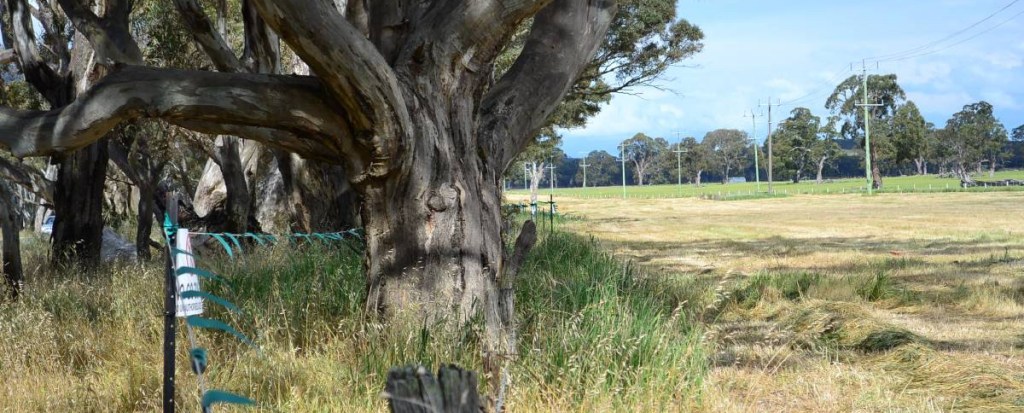
The project’s social and environmental impacts were dramatically underestimated. Deep community concerns, centred on the aboriginal cultural significance of trees and land affected, were omitted or ignored.
State and Federal governments continue to defend the upgrade project and their political decisions. They do this whilst making fantastical claims about future traffic growth, road safety effects and economic worth which have no basis in reality.
The Western Highway is part of Australia’s National Highway network. As such it’s majority-funded by the Commonwealth Government, with top-up support from the State.
It’s the primary highway between Melbourne and Adelaide, as well as linking towns and communities along its length. It also forms a significant part of the intrastate road freight network, carrying agricultural produce to Melbourne and the ports.
The Environment Effects Statement for the project was published back in 2012. It covered the section from Beaufort to Ararat.
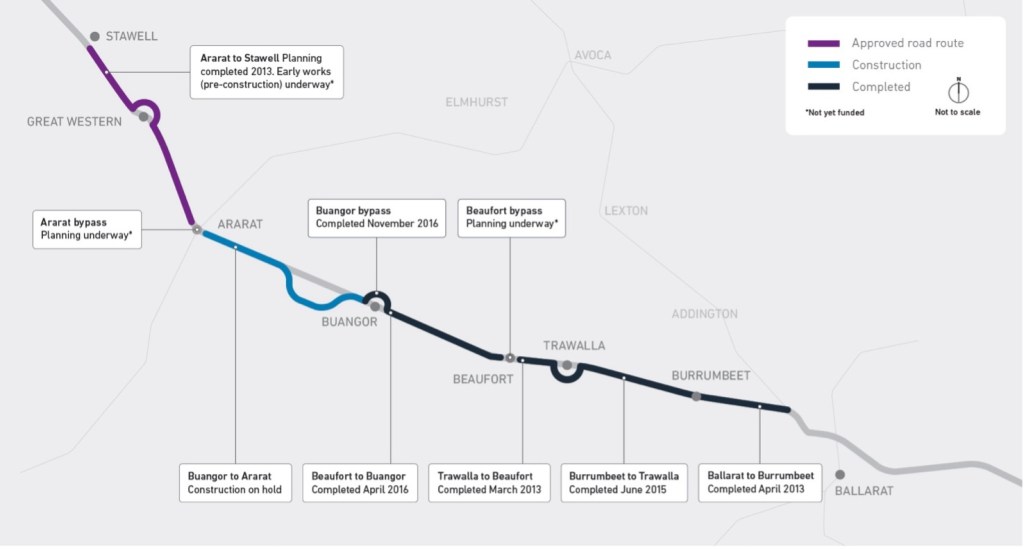
The Beaufort to Buangor part was upgraded by April 2016.
The cultural heritage concerns are centred on the Buangor to Ararat part, where construction has started but has been on hold while court proceedings have taken place.
Road Projects Victoria currently has this to say about the wider Ballarat-Stawell project:
“More than 6000 vehicles travel the Western Highway west of Ballarat each day, including 1500 trucks. This traffic is expected to double by 2025.
In the ten years to January 2021, there have been 152 crashes on the Western Highway between Ballarat and Stawell, including 18 fatalities, and 94 people seriously injured, it is vital for the safety of the community that this road is duplicated.”
Source: https://roadprojects.vic.gov.au/projects/western-highway, February 2022
Traffic volumes have changed little over the last 13 years, and growth has stalled during COVID restrictions. The idea that they’ll double over the next three years is pure fantasy.
The 10-year accident history to January 2021 is quoted for a longer stretch of road (Ballarat to Stawell). I’ve established that no fewer than 6 of the 18 deaths and 10 of the 94 serious injuries happened on sections that were already improved (completed in 2016).
Dan Andrews and other politicians like to quote the 18 deaths as a reason for the upgrade, saying it will save lives. However, 6 deaths over 5 years means that the death rate for the improved sections is the same as that for the unimproved ones (12 deaths over 10 years). There’s no guarantee that the project will save lives on this road.
You can read further details in my original review here.



 William McDougall
Leave a reply to We use energy like we’re emperors – and now we’re addicted – The Fifth Estate Cancel reply